


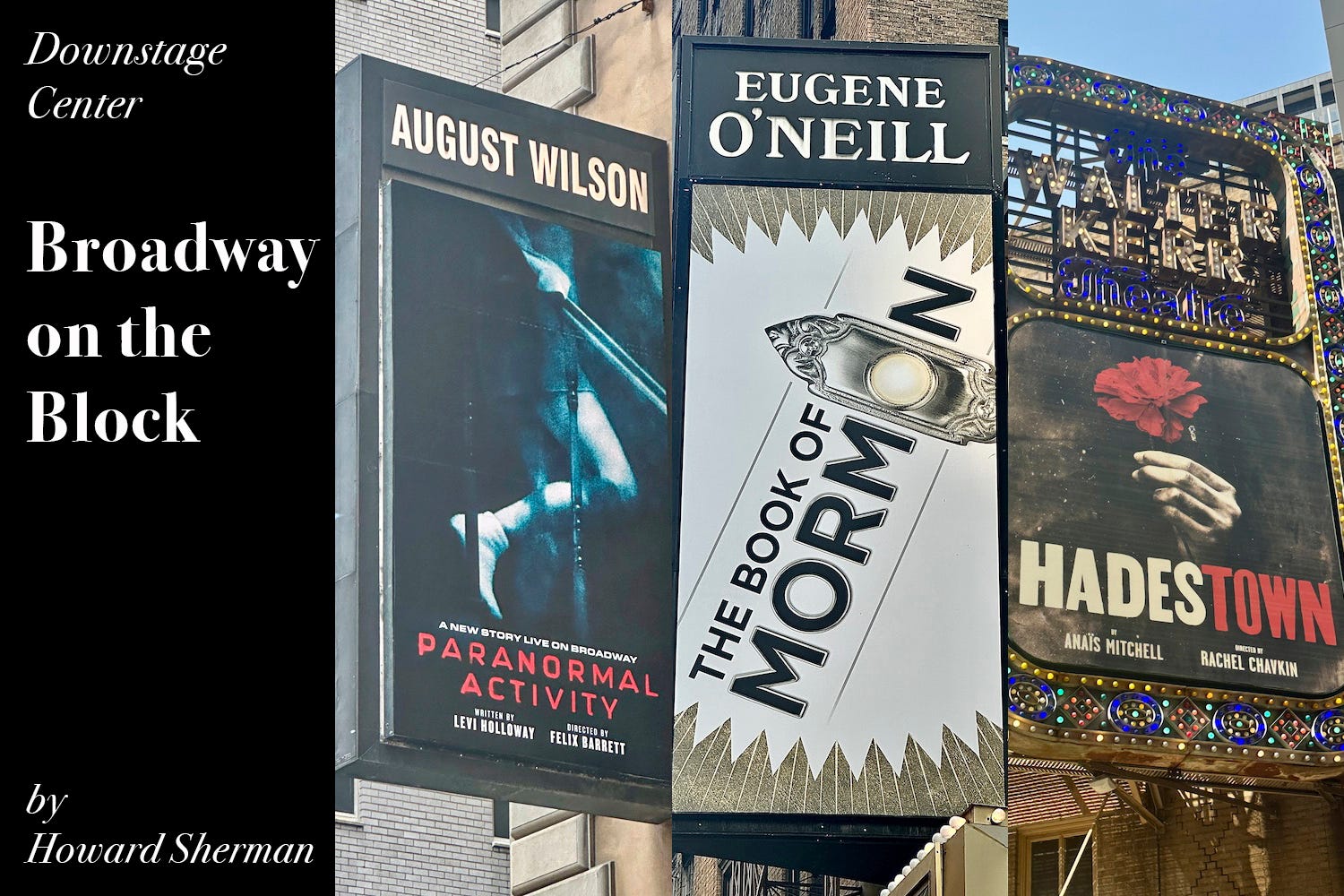
In the wake of MARI’s announced acquisition yesterday of ATG Entertainment, which includes seven Broadway theatres among its more than 60 venues, it seems wise to start any conversation by dispelling some misapprehensions.
1. Broadway is not a monopoly. There are three separate dominant theatre-owning entities, which by definition dispels any monopoly, under which a single owner controls a given market. It’s not even a duopoly. Broadway definitely has concentrated ownership, which gives great power to those three companies, but there also remain a handful of discrete Broadway theatre owners, including Disney, Roundabout, Manhattan Theatre Club, Second Stage and Lincoln Center Theater.
2. The MARI purchase, writ large, makes no immediate change in the balance of power on Broadway. ATG will continue to operate as a brand under the MARI umbrella, with the same management in place. While ATG will report to new corporate ownership, they have already been controlled by Providence Equity Partners since 2013. A controlling stake in the five Broadway theatres which formerly were under the umbrella of privately held Jujamcyn Theatres were sold to ATG in 2023.
3. The sale is unlikely to have any immediate effect on Broadway prices, since supply and demand realities drive pricing (maximized through dynamic pricing that is now the norm) and have the greatest impact on the full-scale prices one encounters on the biggest hits. If there are people willing to pay these heightened prices, they will keep going up. While theatre rent remains an underlying cost that factors into budgeting by producers, it doesn’t dictate pricing, which is set by producers, except insofar as theatreowners, who participate in revenues rather than relying simply on a flat rate, expect ticket prices to reflect as much as the market will bear.
Sorry to start with a primer, especially for those who already know this stuff by rote and will probably declare this an oversimplification. But it helps to set the discussion parameters.
All of that said, why does the MARI purchase make me anxious insofar as Broadway goes? Because, fundamentally, it fully establishes Broadway (and for that matter West End) theatres as commodities in a larger sphere of entertainment. A part of Broadway now must account for itself far beyond Times Square, yet still warrants careful and thoughtful management of NYC landmarks and economic engines in an idiosyncratic and fragile field into the next century.
Much as those who engage with US theatre have long viewed Broadway as the big time, for good or ill, it’s worth remembering that in the grand scheme of entertainment nationally, it is still a comparatively small player. Last year Broadway reached a collective gross of $1.9 billion, which is not insignificant. However movie theatre gross revenue in 2025 was $8.8 billion, on much lower prices, and national in scope; a single film, Spider-Man: Brand New Day, may generate $1 billion in domestic ticket sales alone, even as many fear the continued shrinkage of the theatrical market. Sales of videogames (hardware and software) were $60.7 billion. Netflix’s total gross revenue in 2025 was $45 billion. For perspective on where Broadway fits, in Brian Stelter’s invaluable morning media roundup for CNN today, the ATG sale rated but a single sentence.
What does it mean that seven Broadway theatres, less than 20% of the total, have changed hands again? It puts them in a growing family of entertainment companies ranging from multiple tennis tournaments including the Miami Open and the Frieze Art Fairs to car auctioneers and assorted festivals. This agglomeration of entertainments is quite remarkable when one considers that MARI, led by Hollywood uber-agent Ari Emanuel, was only established in October 2025, so there’s no way of knowing how big it may yet grow with substantial venture capital behind him.
Emanuel spoke out vividly last week in a Wall Steet Journal op-ed in support of the massive Paramount-Warner Brothers merger that is currently consuming Hollywood, so he may well think bigger is better. Will MARI gobble up yet more venues in the US, UK and internationally, yielding a theatrical behemoth? Or will its theatre holdings be a boutique discipline in an ever-larger entertainment powerhouse?
Even with an affection for theatre, which I pray Emanuel has, the theatre unit as a whole will be expected to perform financially, within its scale of course. Should live theatre hit another downturn such as the pandemic, if a spate of underperforming shows yields less revenue over time, if aging venues require disproportionate upkeep, there’s no reason why the ATG theatres couldn’t be offloaded to yet another owner if it’s deemed advantageous to MARI, hence my earlier reference to commodities. Instead of being accountable to people steeped in theatre, even an irrational love for theatre, as in decades past, a piece of Broadway, as it has been under ATG, is answerable to new corporate oversight which may prioritize short-term profit overall, to yield returns for its investors.
While I said that pricing of Broadway tickets may not be immediately affected by the acquisition, I am less sanguine about ticket service charges. MARI also owns TodayTix, a platform that in just over a decade has successfully muscled substantially into the business of selling tickets to Broadway shows. It remains to be seen how that platform and the currently separate ATG Tickets may be brought into alignment, or merged, and whether all of MARI’s holdings might yet be handled by a single ticketing platform akin to the rapacious Ticketmaster, which does no one any favors with its particularly high service charges per purchase.
There is nothing that can be done about the ATG Theatres being in play in the sphere of venture capital; that horse left the barn back in 2013. The seven Broadway theatres to be run by MARI if regulatory approvals are secured have already been but seven in an ATG portfolio of over 60 internationally. Take comfort that the Shuberts and the Nederlanders aren’t about to sell out their operations anytime soon no matter what the bid, though if future Nederlanders don’t want to go into the family business some years hence, that might happen, further altering Broadway on down the line.
MARI’s main option for Broadway growth, outside of forcing outrageous ticket prices, if it were willing to front the money, would be to build Broadway’s newest purpose-built theatre since Roundabout’s Sondheim, expanding its footprint by creating a new venue. The number of seats on Broadway is finite; adding venues adds seats which increases revenue. Perhaps MARI could do what none have managed yet: reactivate the long empty Times Square Theatre in 42nd Street; ATG did a great job bringing the Hudson back online. Overall, though, MARI’s potential for growth of ATG outside NYC is assuredly greater.
With new Broadway ownership, the theatre community itself must once again plead its case for support derived from commercial operations, hoping that ATG will continue or expand its role as a good citizen, as Jujamcyn surely was, supporting theatre charities and the nor-for-profit theatres in New York alike. Whatever some may think of the unique structure of the dominant Shubert Organization, it is legally hand-in-hand with the Shubert Foundation, the single largest funder of theatre and dance across the country. Both the Nederlanders and the Shuberts have a long history of giving back; I confess to being less familiar with ATG support since I’ve been out of that game for a bit.
It’s encouraging to see ATG raising or supplying, per Philip Boroff’s Broadway Journal, $15 million towards the new musical The Curious Case of Benjamin Button, a London transplant, which will play the Public Theater prior to an intended Broadway stint. They see themselves as more than landlords, and it’s important to remember that prolific trans-Atlantic producer Sonia Friedman has a longstanding relationship with ATG.
As Ari Emanuel grows the MARI stable, let’s hope he’ll take some personal interest in Broadway, because he has the resources to have an impact. Ideally he and his lieutenants will take time to sit in aisle seats, not just in their own theatres, not just on Broadway, but around New York and around the country. Theatre may never be MARI’s biggest profit center, but we need the opportunity to cultivate Emanuel and his executive team as aficionados, beyond the balance sheets of profit and loss. He knows entertainment, he knows talent, he may be receptive. Let’s not assume that he is the oft-cited Ari Gold, the craven character on Entourage ostensibly based on him.
Broadway has a new impresario, perhaps once removed (since ATG management remains in place, and I don’t wish to slight them), one with enormous sway in the halls of power beyond Hollywood; his brother is the former Chicago mayor and Obama chief of staff Rahm Emanuel. Whether you like the purchase or not, he’s bought into the Broadway fold. Let’s figure out how to welcome him and make sure he’s a part of our larger team, Team Theatre.
This was a really helpful read -- thank you!
Thank you--this addresses my many questions and some I hadn't thought of.