

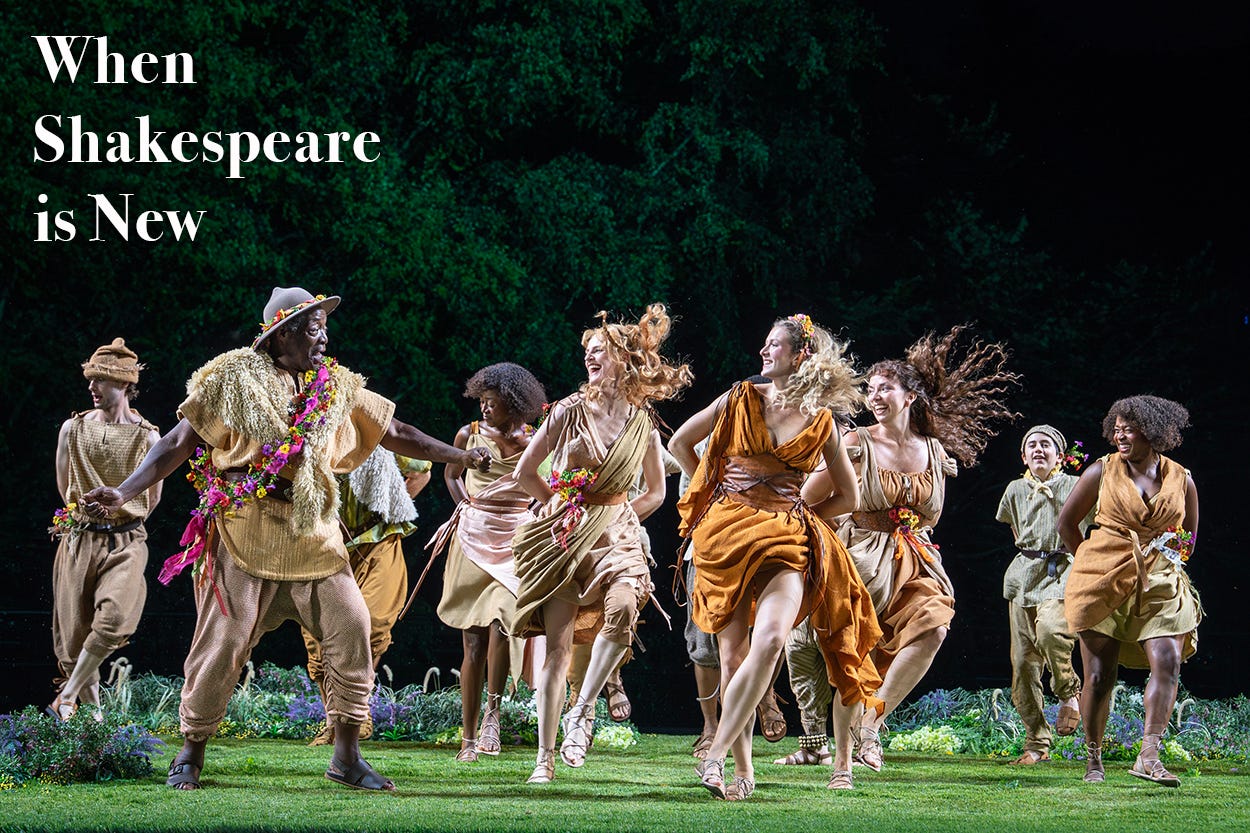
I am living proof that, in one’s seventh decade of life and sixth decade of avid theatregoing, you can see Shakespeare as if new. I refer specifically, in this case, to The Winter’s Tale, now playing in a production directed by Daniel Sullivan at the Public Theater’s Delacorte Theater in Central Park. I speak of this Shakespeare as being new because until last week, I had never seen The Winter’s Tale, nor read it. I hadn’t looked at so much as a summary of the play. Judge me if you will. I was watching a Shakespeare work as if it was new because it was entirely virgin territory to me. I suspect I am not alone in this.
Which set me to thinking about my Shakespeare experiences writ large. I am no novice when it comes to the playwright. Like most American high schoolers, I was required to read several of the plays; in my reveries, Julius Caesar was the first, complete with the requirement that we memorize and recite some of the speeches. I have no memory of what followed, though surely Romeo and Juliet was one of them, and maybe Macbeth. I also recall being taken to Shakespeare on field trips: a Julius Caesar at Yale Rep (with Ron Leibman as Cassius), a screening of the Zeffirelli Romeo and Juliet at a movie theatre one town away from my high school; a Twelfth Night (with Kenneth Haigh as Malvolio) at the long defunct American Shakespeare Theatre in Stratford CT, just two towns away.
While these experiences may seem familiar for many high school students, even if the particulars of plays and productions vary, my actual introduction to Shakespeare was courtesy of my mother, who took me to, of all plays, Measure For Measure, at the Yale Summer Cabaret, circa 1975. Even in a surely cut version, with a platform stage in a low-ceilinged room on the campus, performed in a production by graduate students, I was fascinated. Indeed, that play is so imprinted on my brain that when I read about the new movie One Night Only, which is premised on the country enacting a 364-day-a-year sex moratorium for unmarried folks, I flashed on the similar, but all-encompassing, edict issued by the hypocritical Angelo in the Duke’s absence.
I also recall my mom’s admonition before we went to the Summer Cabaret, urging me to read the play’s summary in her well-worn edition of Charles and Mary Lamb’s Tales from Shakespeare. I can’t recall if I listened to my mom, an elementary school teacher by training, on that occasion, but for so long as I lived at home, she would repeat this recommendation whenever told I was seeing a Shakespeare play. I definitely ignored her after that first foray, much to her consternation and confusion. Her advice served to make the playwright’s work seem difficult, and needing of simplification and preparation.
For all of the teaching of Shakespeare I may have received in high school, I believe I tumbled to the language better through performance, rather than my classmates’ and teachers’ recitations. I was lucky to have had access thanks to a vibrant local professional theatre landscape. Other early Shakespeare that I saw and enjoyed were a Yale Rep production of Timon of Athens, with James Earl Jones in the title role, and a Romeo and Juliet at Long Wharf, with Mary Beth Hurt and Tom Hulce as the young lovers. With shows like this and Measure For Measure among my formative Shakespeariences, I never really understood why any of these plays were a problem.
High school aside, since how deep did we really go in class and how much did we hear performed well aloud, I think of my Shakespeare indoctrination as having largely been sink or swim. I was lucky enough after cursory lessons to stay afloat and paddle successfully into the verse. I think of the experience as akin to understanding Anthony Burgess’s invented future English for A Clockwork Orange once I saw the film, after which the Russian-based slang (“korosho,” meaning “good,” transmutes into “horrorshow” in the Burgess patois) became comprehensible. The novel had been impenetrable to me before seeing the film, despite a glossary, but a breeze once I’d gotten to the movie and heard it used fluently.
So let’s get back to The Winter’s Tale, which I got through (all three hours and 20 minutes of it) with full understanding, despite zero prep, after years of Shakespeare-going. I will confess to briefly peeking at the synopsis in the Playbill, which clarified for me whether two characters were in disguise or whether the actors were doubling, but that was the only glitch of cognition I had. I admit to feeling foolish that I didn’t tumble to it right off, but the economic necessity of many productions drew my focus away from Sullivan’s staging.
Surrounded by more than 1500 theatergoers who secured free tickets, I wondered whether they all had a foundation in Shakespeare, whether they had ever seen the play, whether they had such comfort with the language that they always knew what was being said (and going on). It not being a play that frequently evokes laughter or mid-show applause, I had no way of knowing, but I hoped that, consistent with the ethos that drove Joe Papp to create Shakespeare in the Park so many years ago, there were lots of folks who didn’t have my grounding, and were on their own journey of discovery, not simply of the play but of the playwright. I happily clocked some kids, below high school age, in the crowd and was happy to see them. Oh, to know what they made of The Winter’s Tale.
The memories prompted by my jaunt to The Winter’s Tale were also provoked starting one week earlier, thanks to New York magazine. As part of their Night School email series, which intermittently has the magazine’s writers providing their expertise direct to readers on request, a current offering is “How To Read, Watch and Love Shakespeare,” from their chief theatre critic Sara Holdren. I’ve received two so far, the most recent being “Find Your Inner Groundling”; the upcoming entry was advanced thusly: “Next week, we get iambic all over everybody’s ass — and trochaic and anapestic and all that good stuff.” As anyone who reads Sara regularly will know, these missives are smart, insightful, funny, detailed, and anything but stuffy. They are definitely another way to come to Shakespeare and despite my immersion over decades, which included eight years working for expert Shakespeare director Mark Lamos, Sara reaffirms for me that there are always countless nuances to discover.
Shakespeare can be taught, and there are surely many ways to teach Shakespeare, a reminder that there is no one way to approach this canonical playwright. And there’s always more to learn from him, especially if you haven’t seen all of the plays – I’ve still never seen The Comedy of Errors (though yes, I’ve seen The Boys From Syracuse more than once), Two Gentleman of Verona (though I’ve seen the musical), Henry VIII, King John, or Troilus and Cressida. I’m not a completist, so I’m not trying to check these off on a scorecard, though I’m certainly curious. At the same time, I’ve seen three Timon of Athens, three Cymbelines and countless Twelfth Nights, Much Ados, Macbeths, and Hamlets (Christopher Walken, Richard Thomas, and Oscar Isaac among the last), among many others.
But when asked what path people should take to Shakespeare, I’ll always favor seeing the work first, and doing any desired reading after, because then it is alive in a way that only studying it can’t quite match. That said, I know there are people who like to listen to musical theatre recordings of shows before seeing them, to get comfortable with the music and fully take in the lyrics; I respect that, even if I don’t share that predilection.
My greatest lesson in this came from visiting the Stratford Festival years ago with two friends who had little experience with the plays, yet by their choice, we would be seeing The Tempest. I vividly recall their intermission puzzlement, with them saying to me – knowing I was more versed in the plays – “We can’t understand what anyone is saying, except for the guy playing Prospero. Why is that?” In memory, the production overall was not brilliantly realized, but the Prospero, played by Canadian stage legend Douglas Rain, was riveting. “You know what he’s saying,” I replied, speaking of the beautifully nuanced and very late career performance, “because he knows what he’s saying.” The actor’s comprehension conveyed the meaning, and through that, Shakespeare spoke across the centuries, loud and clear.
Photo credit: members of the company in The Winter’s Tale at The Public Theater’s Delacorte Theater (Photo by Joan Marcus)
WHAT I’M WATCHING Last week I polished off Netflix’s Man on Fire, a fairly rote story of spies and revenge, but it’s held together and raised above average by a strong central performance from Yahya Abdul-Matteen II, seen on Broadway in the revival of Suzan-Lori Parks’ Topdog/Underdog a couple of years ago. Now I’m at the halfway point of You Don’t Know Me, an intriguingly plotted courtroom drama that consists entirely of the defendant, accused of murder, who is acting as his own counsel, making a detailed summation (with events shown in flashback) in lieu of having testified. After this 2022 film, with a cast of British actors unfamiliar to me, lead Samuel Adewunmi appeared in the West End in the Almeida Theatre production of A Mirror.
WHAT I’M SEEING No theatre on tap this week so far, but I have my ticket to see the proshot of the musical Six on Saturday. I was surprised to find that most theatres in the New York area were only offering one screening each day, and found that to be true in Los Angeles and Chicago as well (I searched via Fandango). If this release pattern holds true nationally, then it will be fairly difficult for the film to come close to the success Hadestown managed just two weeks ago.
WHAT I’M LISTENING TO I am not a regular podcast listener, as they command my full attention, making it hard to do anything else when listening. But I made an exception for the most recent Caropop edition, because host Mark Caro, a college newspaper colleague of mine, was talking with my friend Laura Benanti, on the occasion of her touring show Nobody Cares playing at Steppenwolf in Chicago. If you enjoy Laura, as I certainly do, give a listen.
When I was in college, I wandered over to the campus movie theater out of boredom and watched a film I had never heard of, Gus Van Sant's "My Own Private Idaho." The experience of watching this Shakespeare-quoting masterpiece without knowing what it was changed my life and my interactions with art. I was a professional theater critic for more than a decade, and what I cherished above all else was the opportunity to experience a work without any preconceptions getting in the way. Now, AFTER watching that August Wilson play or ancient Greek tragedy, I would do some research before finalizing a review, just to make sure I wasn't missing something that would have me eating crow for life.